Fibration: Difference between revisions
No edit summary |
|||
| (One intermediate revision by the same user not shown) | |||
| Line 3: | Line 3: | ||
==Definition== | ==Definition== | ||
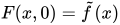
A [[continuous map]] <math>p:E \to B</math> of [[topological space]]s is termed a '''fibration''' or is said to have the '''homotopy lifting property''' if, given any map <math>F:X \times I \to B</math> and a map <math>\tilde{f}: X \to E</math> such that <math>p(\tilde{f}(x)) = f(x,0)</math>, there exists a map <math>\tilde{F}:X \times I \to E</math> satisfying: | A [[continuous map]] <math>p:E \to B</math> of [[topological space]]s is termed a '''fibration''' or is said to have the '''homotopy lifting property''' if it is ''surjective'' and, given any map <math>F:X \times I \to B</math> and a map <math>\tilde{f}: X \to E</math> such that <math>p(\tilde{f}(x)) = f(x,0)</math>, there exists a map <math>\tilde{F}:X \times I \to E</math> satisfying: | ||
* <math>p \circ \tilde{F} = F</math> | * <math>p \circ \tilde{F} = F</math> | ||
Latest revision as of 00:45, 25 December 2010
This article defines a property of continuous maps between topological spaces
Definition
A continuous map of topological spaces is termed a fibration or is said to have the homotopy lifting property if it is surjective and, given any map and a map such that , there exists a map satisfying:


This is dual to the notion of a cofibration.
Relation with other properties
Weaker properties
- Weak fibration (also called Serre fibration)